The problem
Why a spreadsheet makes a poor school bus route planner.
- A new child, a new address or a new bell time means redrawing several routes, not one.
- Buses run half empty on some routes and over capacity on others.
- Kindergarten, primary and secondary leave at different times, and the afternoon plan has to follow.
- The plan lives in one person's head and one spreadsheet, and both take holidays (how to plan school bus routes, with or without software).
How Trayvar solves it
How the school bus routing platform plans the day.
01
School bus stop planning: hubs and home pickup
Nearby homes are grouped into pickup hubs. Where the school expects each child collected from home, door pickup runs beside hubs on Growth and Scale.
02
Sequenced against your constraints
Student transportation routing carries more constraints than a delivery round. The optimiser sequences every route against vehicle capacity, boarding time, bell times and road distances, and takes traffic into account on Scale.
03
Afternoon runs by dismissal time
Afternoon runs split by dismissal time, so kindergarten, primary and secondary each go home on their own run. School bus scheduling software has to get this right, and a single afternoon plan cannot.
04
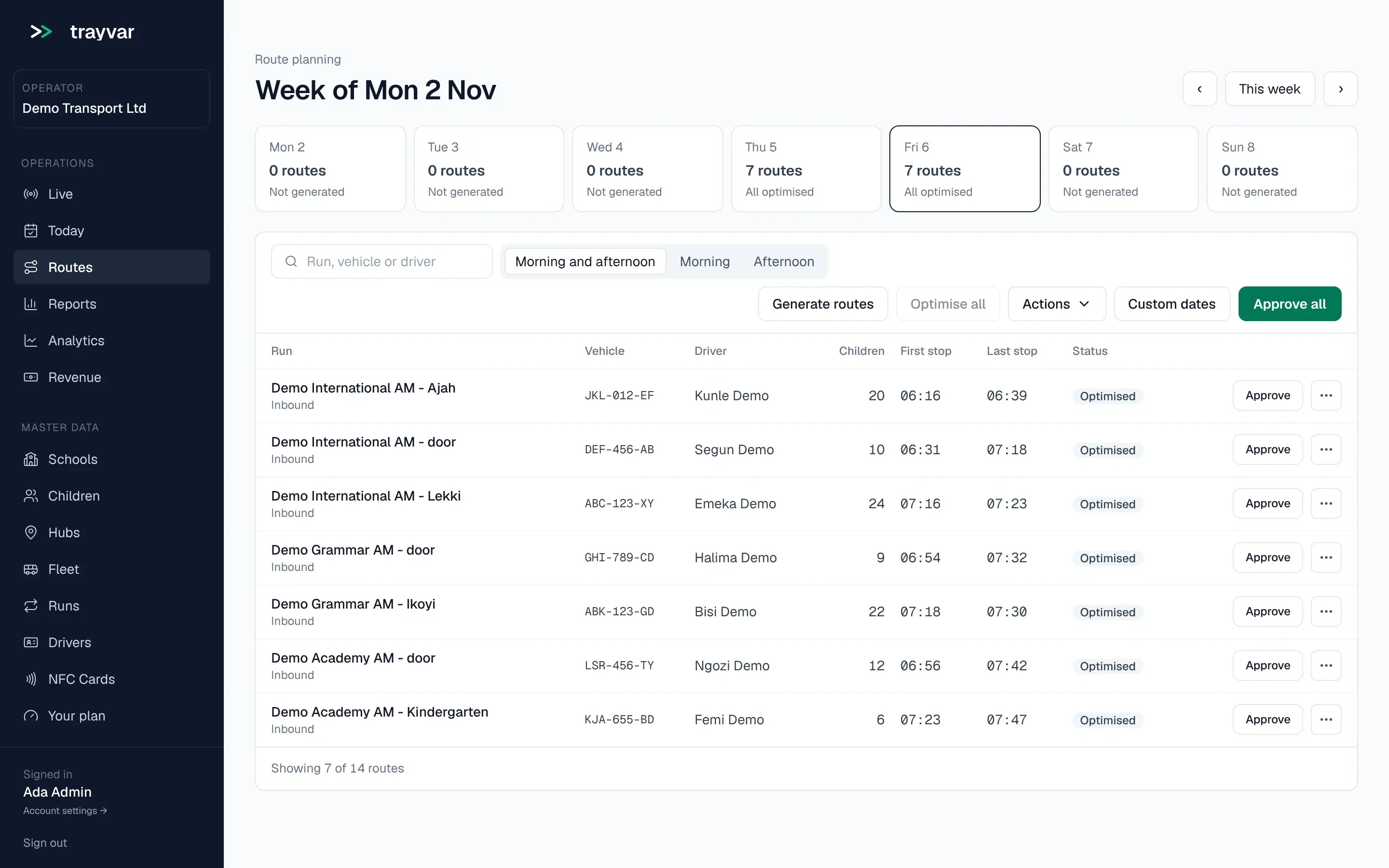
Approved before anyone drives
No school route planner, by hand or in software, should send a plan out unchecked. Plans are reviewed and approved route by route or all at once, and runs that would share a driver or a vehicle at the same time are flagged before approval.
The evidence
What school bus route planning software should let you check.
- The operations report shows planned and measured distance for each route, so the plan can be held to account.
- Load factor and on-time performance are reported by run, driver and school.
- Each school you serve receives a service report on its own routes and children.
Questions and answers
How long does it take to plan school bus routes?
Trayvar's optimiser plans every route overnight on Growth and Scale, and runs route by route when you ask on Starter. Someone on your team reviews the plan in the morning and approves it route by route or all at once.
Can a route mix hub stops and home pickups?
Yes, on Growth and Scale: nearby homes are grouped into pickup hubs while other children are collected from home, and both run side by side. Every run uses hub stops on Starter.
What does the school bus routing system take into account?
Vehicle capacity, boarding time, bell times and road distances, with traffic added on Scale. Afternoon runs split by dismissal time for kindergarten, primary and secondary.
Is there free school bus routing software?
Trayvar is not free. It is priced per vehicle per month, from $29 on the Scale tier with annual billing, and there are no fees to set up. Every tier is on the pricing page.
Is there a school bus routing app for drivers?
Yes. The school bus driver app shows each driver the day's stops in order on a street map, works offline and on 2G, and records each child boarding with an NFC tap.
Is automated school bus routing on every tier?
No. Automated school bus routing, where the optimiser plans every route overnight by itself, comes on Growth and Scale. The optimiser runs route by route when you ask on Starter, and someone on your team approves every plan before it runs.
See it against your own routes.
A demo takes the platform through your own fleet, schools and bell times. We come back within 48 hours.